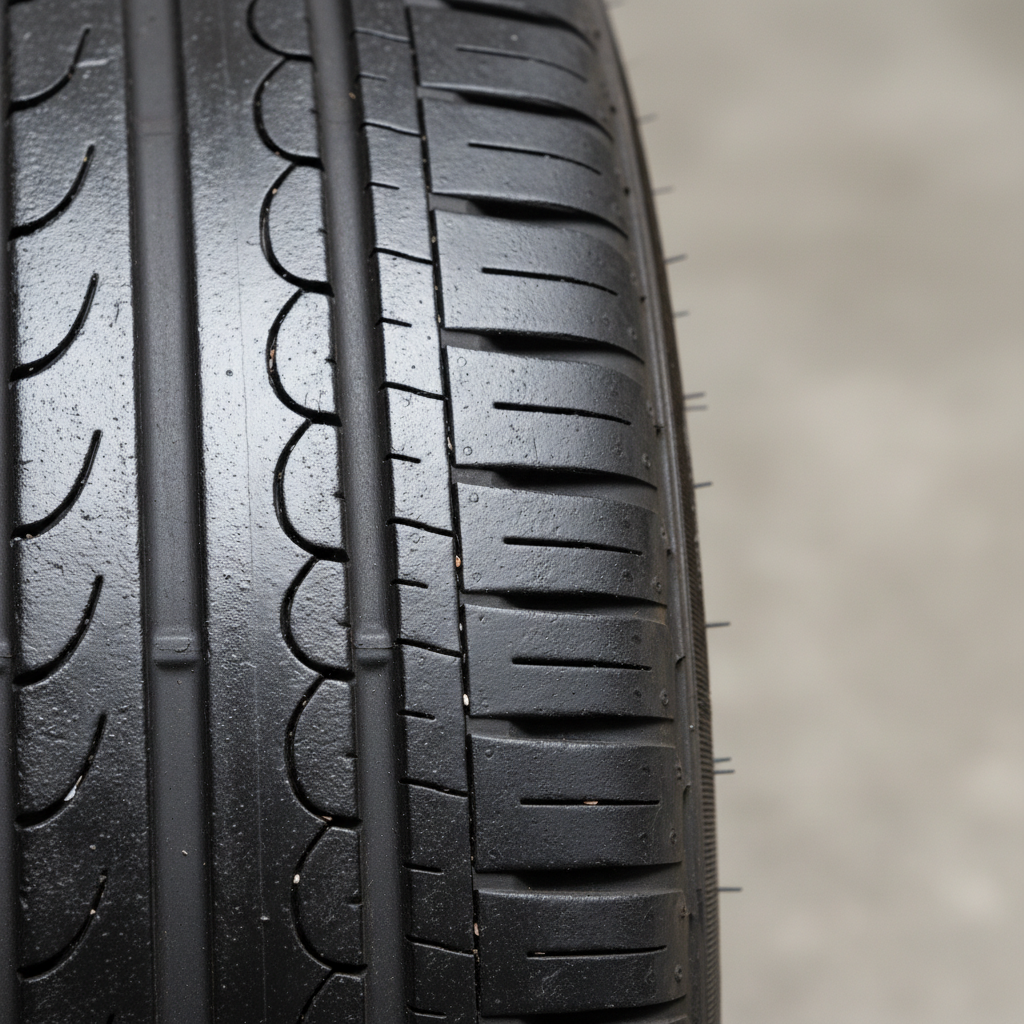
Reading Tire Wear Patterns to Diagnose Vehicle Problems
Your tires are keeping a record of everything that is happening with your vehicle's alignment, inflation, and suspension. Every mile you drive, the rubber wears in a pattern that reflects the forces acting on it. Learning to read those patterns gives you a diagnostic tool that does not require any special equipment. All it takes is a visual inspection and the knowledge of what to look for.
This guide covers the most common tire wear patterns, what causes each one, and what repairs are needed to correct the underlying problem.
Center Wear: Overinflation
When a tire is consistently overinflated, the center of the tread bulges outward and carries more of the load. This causes the center of the tread to wear faster than the edges, creating a strip of worn rubber down the middle of the tire while the shoulders retain more tread depth.
The cause is straightforward: too much air pressure. Many drivers inflate their tires to the maximum pressure listed on the tire sidewall, but this is the maximum pressure the tire can safely hold, not the recommended operating pressure. The correct pressure for your vehicle is listed on a placard typically found on the driver's door jamb or in your owner's manual. For most passenger vehicles, the recommended pressure is between 30 and 35 PSI, which is significantly lower than the 44 or 51 PSI maximum listed on many tires.
The fix is to adjust your tire pressure to the vehicle manufacturer's specification and check it monthly. Tires naturally lose about 1 PSI per month, and pressure changes approximately 1 PSI for every 10-degree Fahrenheit change in ambient temperature. Regular monitoring keeps your pressure in the right range.
Edge Wear: Underinflation
The opposite of center wear, edge wear occurs when a tire is consistently underinflated. Low pressure causes the tire to flex more than it should, and the edges of the tread carry a disproportionate share of the load. Both shoulders of the tire wear faster than the center.
Underinflation is more dangerous than overinflation because it generates excessive heat in the tire sidewall. Heat is the primary enemy of tire longevity and structural integrity. A severely underinflated tire driven at highway speed can overheat to the point of structural failure, resulting in a blowout. This is why tire pressure monitoring systems (TPMS) are required on all vehicles sold in the United States since 2008.
The fix is the same as for overinflation: set your tires to the manufacturer's recommended pressure and check regularly. If you find that one tire consistently loses pressure faster than the others, it may have a slow leak from a nail, a bead seal issue, or a valve stem problem that should be addressed.
One-Sided Wear: Camber or Toe Misalignment
When a tire wears significantly more on one edge than the other, the most common cause is a wheel alignment problem, specifically excessive camber or toe.
Camber refers to the tilt of the wheel when viewed from the front of the vehicle. If the top of the wheel tilts outward (positive camber), the outside edge of the tire wears faster. If the top tilts inward (negative camber), the inside edge wears faster. Inner edge wear is far more common because many alignment issues push camber negative, and drivers are less likely to notice inner edge wear since it faces away from them.
Toe refers to whether the wheels point slightly inward (toe-in) or outward (toe-out) when viewed from above. Improper toe causes a feathering or scrubbing wear pattern where one side of each tread block wears more than the other. You can feel this pattern by running your hand across the tread. It will feel smooth in one direction and rough in the other, like running your hand against a saw blade.
One-sided wear requires an alignment correction, but here is the critical step most people miss: the alignment problem may be caused by worn suspension components. Control arm bushings, ball joints, and tie rod ends all affect alignment angles. Getting an alignment without replacing worn components is a temporary fix because the worn parts will allow the alignment to shift again immediately. A good shop will inspect suspension components before performing an alignment and recommend replacing worn parts first.
Cupping or Scalloping: Worn Shocks or Struts
Cupping appears as a series of scalloped dips around the circumference of the tread. If you run your hand along the tire, you will feel alternating high and low spots that create a wavy surface. This pattern is caused by the tire bouncing as it rolls down the road instead of maintaining consistent contact with the pavement.
The primary cause of cupping is worn shock absorbers or struts. When these components lose their damping ability, they cannot control the spring oscillation, and the tire literally bounces with each road imperfection. Each bounce lifts the tire slightly off the road and then slams it back down, wearing a dip in the tread at each contact point.
Cupping can also be caused by unbalanced tires, bent wheels, or worn suspension bushings that allow excessive movement. The fix typically involves replacing the worn shocks or struts, correcting any other contributing factors, and replacing the cupped tires. Unfortunately, cupped tires cannot be saved. Even after the shock replacement, the irregular surface will continue to produce noise and vibration.
Diagonal Wear: Multiple Alignment Issues
Diagonal wear, where the tire shows a pattern that runs at an angle across the tread face, typically indicates a combination of alignment issues. It is most common on rear tires of front-wheel-drive vehicles where the rear alignment is out of specification. The combination of camber and toe errors creates a force that wears the tire in a diagonal pattern.
This pattern is more difficult to diagnose by visual inspection alone because it does not fit neatly into one category. A four-wheel alignment check will reveal the specific angles that are out of specification, and correction will stop the abnormal wear on new tires.
Flat Spot Wear: Brake Lock-Up or Extended Parking
A flat spot on a tire, where one area of the tread is worn significantly more than the rest, is usually caused by one of two things. Brake lock-up during a hard stop can wear a flat spot in the rubber at the point of contact where the tire skidded on the pavement. Extended parking, where the vehicle sits in one position for weeks or months, can also create a flat spot from the constant weight on one section of the tire.
Flat spots from brake lock-up are permanent and can cause vibration at speed. If the flat spot is minor, it may be tolerable. If it is severe enough to cause noticeable vibration, the tire should be replaced. Flat spots from extended parking are often temporary and may work themselves out after a few miles of driving as the tire warms up and the rubber flexes back to its normal shape.
Patch Wear: Improper Tire Rotation
Tires that are never rotated develop wear patterns specific to their position on the vehicle. Front tires on a front-wheel-drive vehicle wear faster on the outer edges due to the forces of turning and weight transfer during braking. Rear tires on the same vehicle may develop a heel-toe pattern from being dragged around corners.
Regular tire rotation, typically every 5,000 to 7,500 miles, distributes wear evenly across all four tires and extends their useful life. The rotation pattern depends on your vehicle's drivetrain. Front-wheel-drive vehicles rotate differently than rear-wheel-drive or all-wheel-drive vehicles. Your owner's manual or tire shop can specify the correct pattern.
How to Inspect Your Tires
You do not need special tools to check for wear patterns. Walk around your vehicle and look at each tire. Compare the tread depth at the inner edge, center, and outer edge. Check for any obvious irregularities, scalloping, or one-sided wear. Run your hand across the tread to feel for cupping or feathering that may not be visible.
Do this check monthly when you check your tire pressure. Catching a wear pattern early means you can correct the underlying cause before it destroys the tire. A tire with mild inner edge wear from a slight alignment issue can be saved with a prompt alignment. A tire with severe inner edge wear, where the cords are nearly exposed on one side while the other side has full tread, is beyond saving.
If you notice any abnormal wear, bring the vehicle to a shop for a full alignment check and suspension inspection. The wear pattern will help the technician identify the likely cause, but measurements of the alignment angles and suspension components are needed to confirm the diagnosis and make the correct repair.